We spend our whole lives moving around in three dimensions: up-down, left-right, and forward-backward. It’s so natural that we don’t even think about it. But in mathematics, there’s no rule saying you have to stop at three. In fact, mathematicians work with ‘n-dimensions’ all the time.
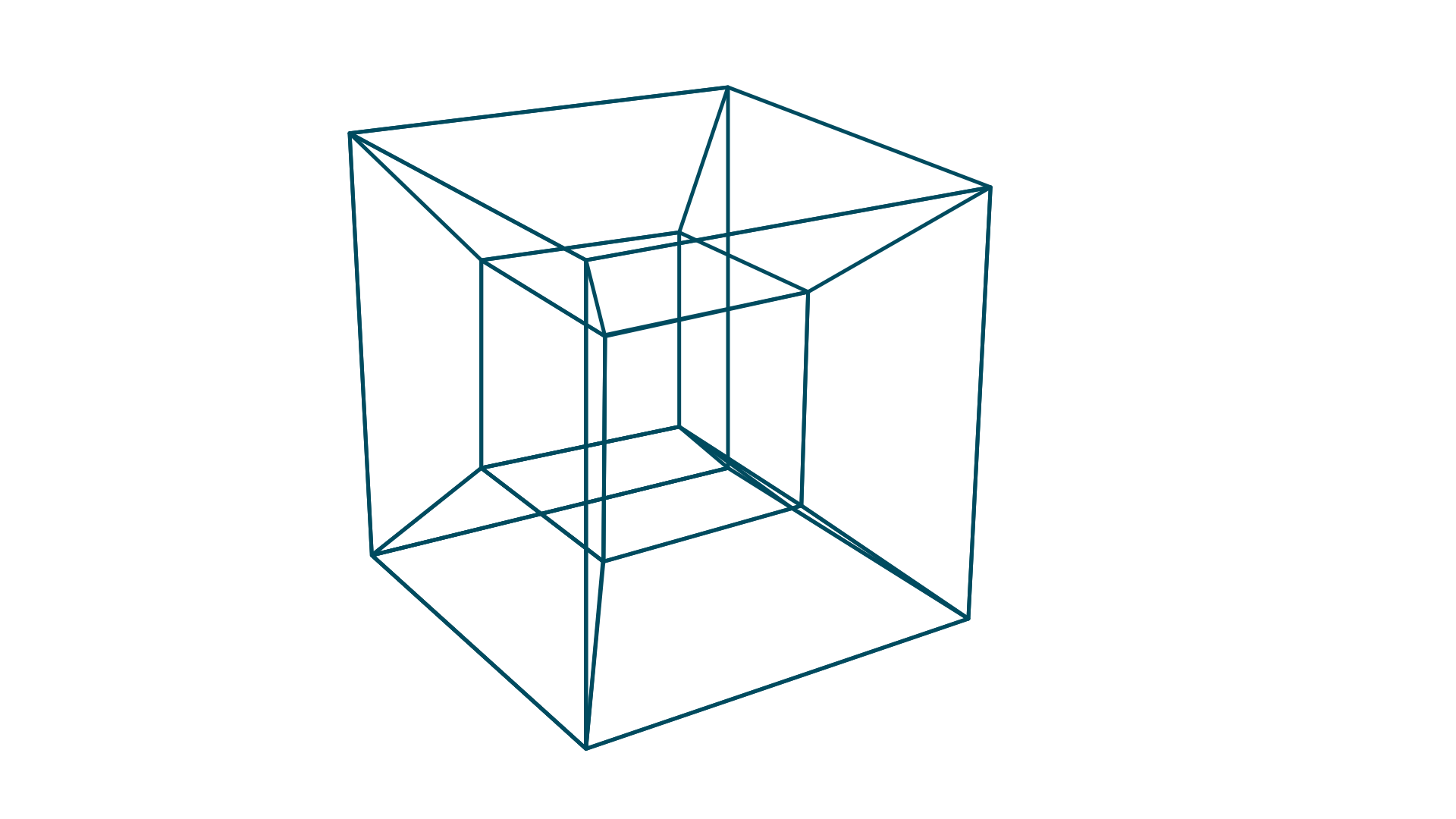
The most interesting jump is from 3D to 4D. Since we can’t actually see a fourth direction, how do we know what a 4D shape – like a Tesseract – looks like?
Building the Dimensions
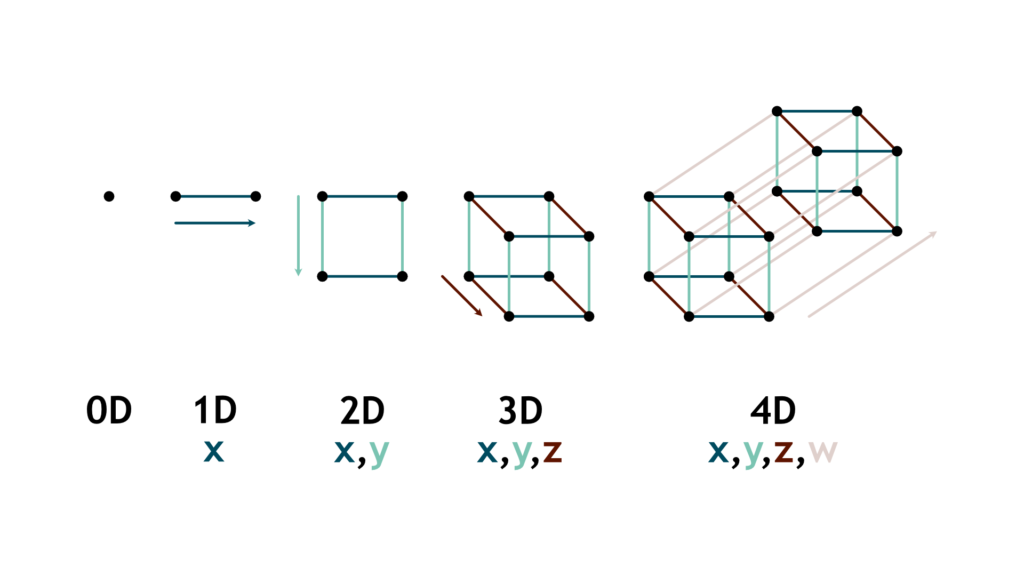
The best way to understand the 4th dimension is to look at the ‘shadows’ left behind by lower dimensions.
- 0D: A single point. It has no size and can’t move.
- 1D: Pull that point into a line. It has length.
- 2D: Pull that line sideways to make a square. It has length and width.
- 3D: Pull that square ‘up’ to make a cube. It has length, width, and height.
- 4D: Pull that cube in a direction we can’t point to. That creates a Tesseract.
How to see a Tesseract
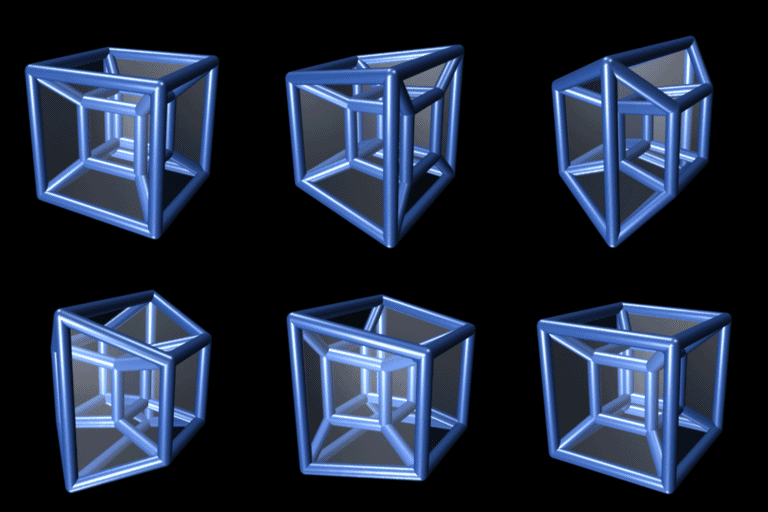
Since our brains are wired for 3D, we can’t see a Tesseract in its true form. Instead, we see its projection, kind of like how a 3D cube casts a 2D shadow on a wall.
When you look at a drawing of a Tesseract, it usually looks like a small cube inside a larger cube, with the corners connected by diagonal lines. In 4D space, all those diagonal lines are actually the same length as the edges of the cube, and every angle is a perfect 90 degrees! It only looks squashed to us because we are trying to fit 4D information into a 2D screen or 3D space.
The Net Trick
Think back to when you learned about nets- the 2D flat shapes you fold up to make a 3D cube. A cube’s net looks like a cross made of six squares.
If a 2D square folds into a 3D cube, then a 3D net can fold into a 4D Tesseract! The net of a Tesseract is made of eight cubes joined together in a cross shape. This is called a Dalí Cross). If you were a 4D being, you could fold those eight cubes together until they occupied the same 4D space.
Why Do Mathematicians Care?
This isn’t just about drawing cool shapes. 4D maths is used in:
- Physics: Einstein used 4D maths to explain space-time (where time is the 4th dimension).
- Data Science: When a computer looks at 10 different variables (like price, age, weight, etc.), it treats that as a 10-dimensional shape to find patterns.
- Computer Graphics: To make objects rotate realistically in video games, programmers use 4D complex numbers called quaternions.
Next time you’re sitting in class, try to imagine a direction that isn’t up, down, or sideways. You can’t do it – but thanks to maths, you can still calculate exactly what’s happening there!