Mathematics is often described as a universal language, but in 2025, it felt more like a universal bridge. This past year, the mathematical community didn’t just solve isolated puzzles – they connected long-separated islands of thought. We saw the bridge between the motion of individual atoms and the flow of giant oceans, the bridge between abstract algebra and complex calculus, and even a bridge between the limits of human logic and the raw power of supercomputers.
From the intense competitive spirit of the world’s brightest students to ground-breaking proofs that settled century-old debates, here are the five stories that defined the year in mathematics.
From atoms to oceans: Hilbert’s Sixth Problem near solution

One of the deepest mysteries in science is how simple things become complex. We know that water is made of individual molecules (atoms), and we know how a river flows (fluid dynamics). But for 125 years, we lacked a perfect mathematical proof showing exactly how the chaotic ‘bounce’ of atoms turns into the smooth ‘flow’ of a wave. This is a major part of Hilbert’s Sixth Problem.
In 2025, a landmark proof finally connected the Boltzmann equation (which tracks particles) to the Navier-Stokes equations (which track fluids). By proving this link, mathematicians have given scientists a ‘guarantee’ that our weather models and airplane wing designs are built on a solid foundation of particle physics. It is the ultimate proof that the small world and the big world obey the same logic.
A lifetime of building bridges: Abel Prize awarded to Masaki Kashiwara
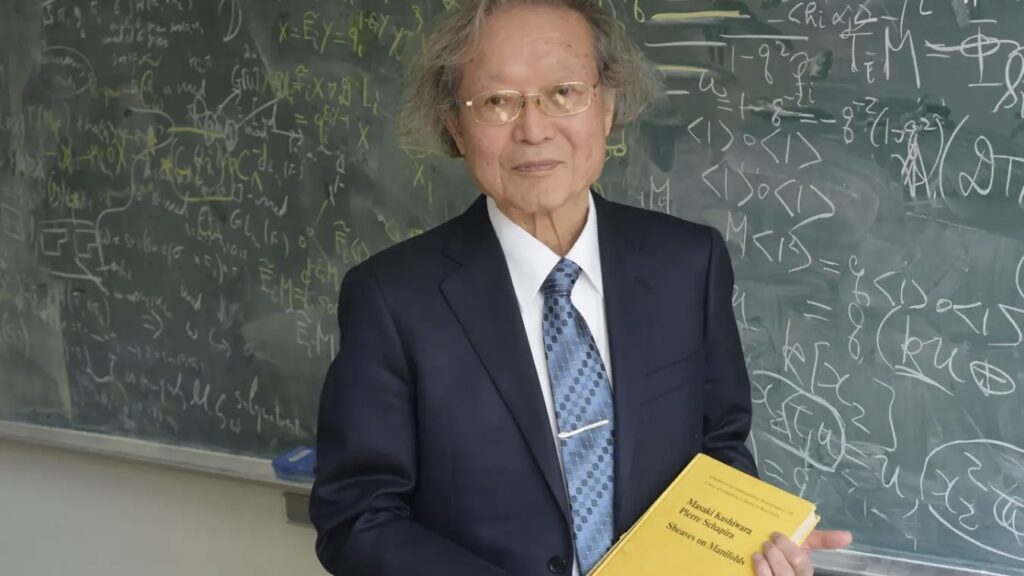
In March, the closest thing to a Nobel Prize of Mathematics – the Abel Prize – was awarded to Masaki Kashiwara of Kyoto University. While his work is highly technical, the core idea is something anyone can appreciate: translation.
For centuries, mathematics has been split into different ‘dialects’. There is algebra, the study of structures and equations, and analysis, the study of continuous change, like calculus. Kashiwara spent his career proving that these two worlds are actually talking about the same thing.
Through his development of D-modules, he created a way to take a difficult problem in calculus and ‘translate’ it into a simpler problem in algebra. This isn’t just a trick for the classroom – it is the framework that modern physicists use to understand the symmetries of the universe. His prize celebrates a lifetime of proving that in mathematics, everything is more connected than it looks.
The needle in the box: Solving the Kakeya Conjecture
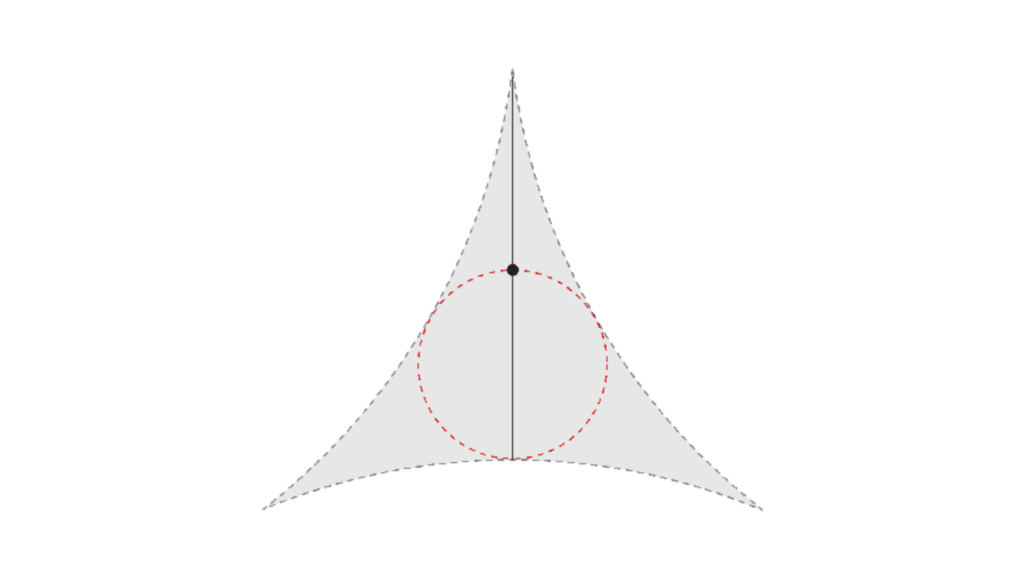
Imagine you have a needle, and you want to rotate it 360 degrees in a box. How small can that box be? This sounds like a simple puzzle, but it is known as the Kakeya Conjecture, and it has been one of the toughest problems in geometry for a century.
In 2025, mathematicians Hong Wang and Joshua Zahl finally solved the version of this problem for 3D space. They proved that while these ‘needle-turning’ shapes can be very strange and ‘holy’, like a fractal, they must still occupy a full three dimensions of space.
Why does this matter? It turns out that the way a needle rotates is mathematically identical to how waves, like light or sound, interfere with each other. Solving this geometry puzzle gives engineers and physicists new tools to understand how signals travel through space without getting blurred or lost.
Young talent overshadowed by AI at the 2025 International Mathematical Olympiad
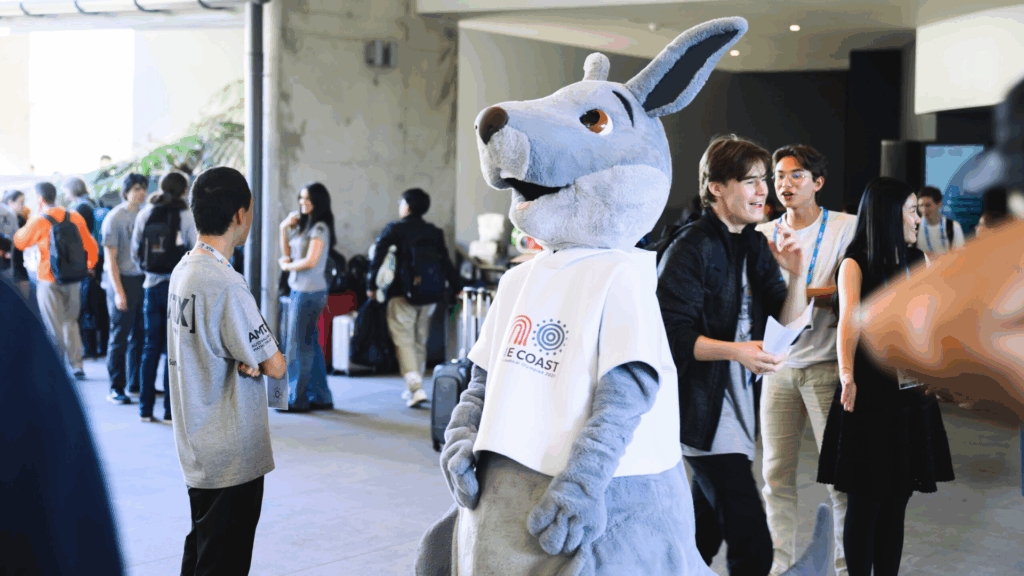
In July, the 66th International Mathematical Olympiad (IMO) brought 630 of the world’s most brilliant teenagers to the Sunshine Coast of Australia. This is the highest competition in mathematics, where students tackle six problems so difficult that even professional mathematicians often struggle to solve them in the allotted time.
The IMO’s most successful country China returned to their dominance of the competition, its team taking a clean sweep of gold medals with two of their mathletes even achieving perfect scores. The USA continues to be a formidable IMO nation, taking its tenth top-two placing in the last 11 years with five gold medals and one silver medal. Meanwhile, South Korea maintained its reputation for consistency with four golds and two silvers, an outstanding achievement for a country with a significantly smaller population than others at the top of the rankings.
There was a wave of delight and pride across social media as India achieved its best-ever score of 193 points, coming seventh in the table. The country’s rapid IMO rise has seen it score nine gold medals in the last three years. Vietnam affirmed its reputation as an up-and-coming IMO country, securing 188 points with standout performances in geometry and combinatorics.
Another major headline coming out of Australia was that for the first time in IMO history, artificial intelligence was formally evaluated alongside human contestants and the results were startling. Both Google DeepMind’s Gemini and OpenAI’s unnamed LLM submitted full solutions to the six official problems, graded independently by former IMO medalists. Each model scored 35/42, matching the gold medal threshold and outperforming over 90% of human participants.
The announcement sparked controversy though as OpenAI released its results before the official closing ceremony, prompting criticism from IMO organisers and rival labs. Google responded with a pointed statement: “We respect the IMO’s timeline. The spotlight belongs to the students.” The incident reignited debates about AI’s role in education, competition, and intellectual recognition.
AI is now capable of solving Olympiad-level problems, not just numerically, but with structured, readable proofs. Whether this marks the beginning of collaborative learning or competitive displacement of human ‘mathletes’ remains to be seen.
From 3.14 to 314 trillion digits: breakthrough in computing Pi
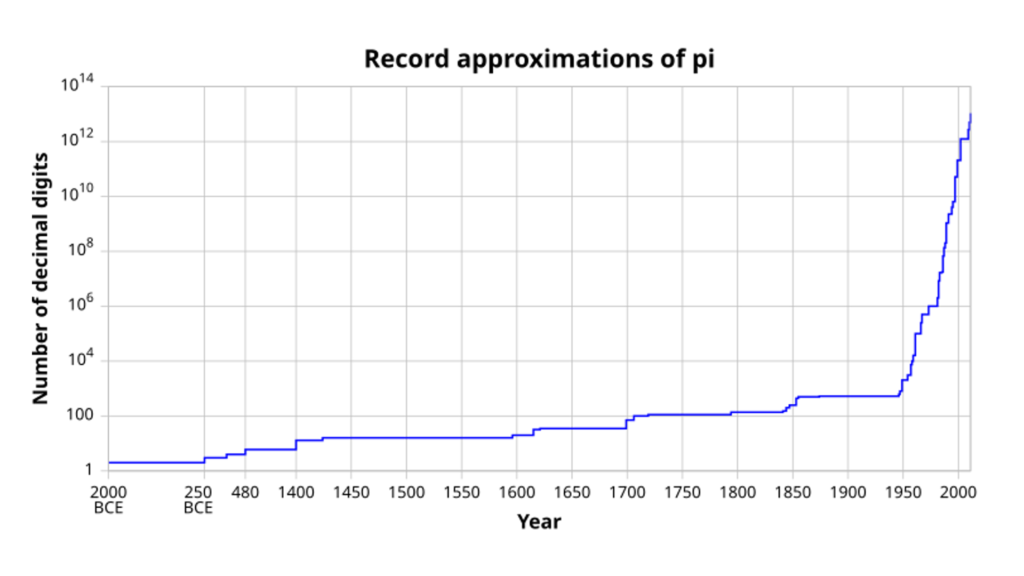
Most of us only need to know Pi = 3.14 to get through a school exam. Even NASA only uses about 15 decimal places to land spacecraft on Mars. However, in December 2025, a team at StorageReview pushed the precision to a staggering 314.159 trillion digits.
Why spend months of computer time on this? It isn’t about the number itself; it’s a hardware ‘torture test’. It tests if a computer can run at 100% capacity for months without a single error.
Managing this much data requires 2.5 petabytes of storage, roughly the same as 500,000 high-definition movies. Mathematicians are now scanning these trillions of digits to see if every number, 0 through 9, appears as often as it should. If Pi is ‘normal,’ it contains every possible numerical sequence – including your birthday, your phone number, and even the coded text of every book ever written.
The overarching theme of 2025 was synthesis – the joining of different ideas into a single, clearer picture. We are moving away from an era where mathematicians work in silos and moving into an era where geometry, algebra, and physics are seen as parts of the same whole.
As we look toward 2026, the next big step is verification. As these proofs become longer and more complex, we are starting to use AI and ‘proof assistants’ to double-check the work of humans. The goal is a future where we don’t just ‘think’ a solution is right, but we know it with absolute, machine-verified certainty.