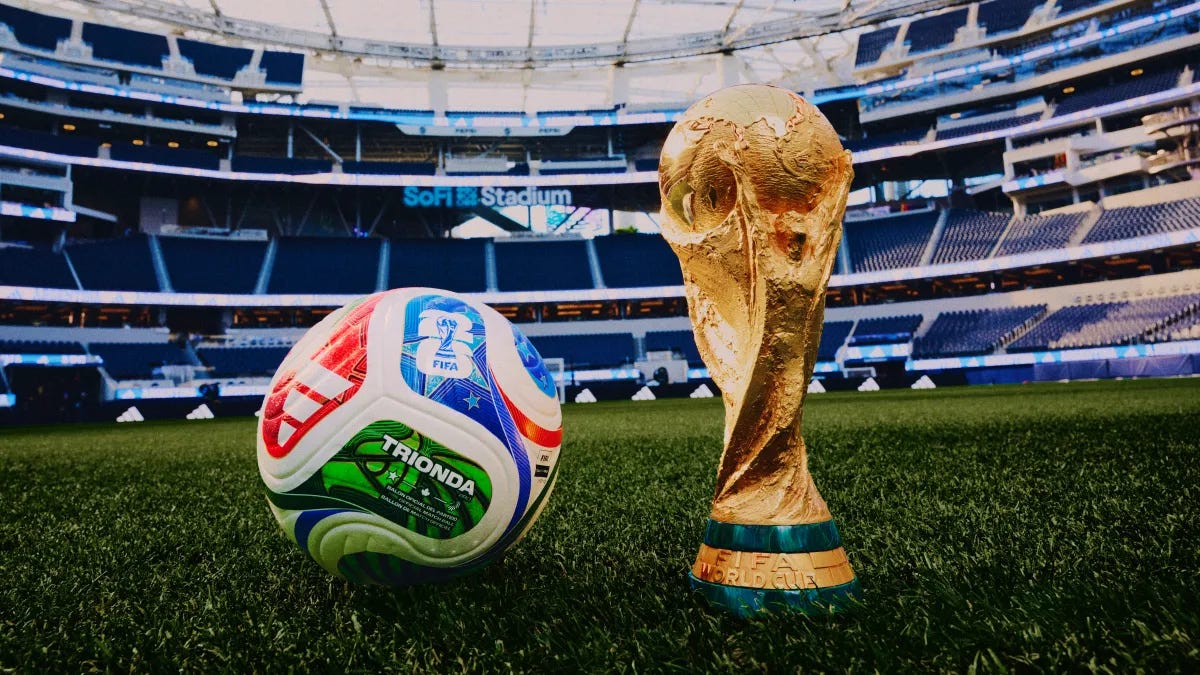
The FIFA World Cup 2026 is one of the biggest, most renowned tournaments in sporting history. But just how much does the tournament, and football more generally, rely on the mathematical world?
The football itself – a Trionda
All FIFA World Cup balls have been based on something called a platonic solid. These are shapes with identical faces that all meet in the same way. The classic football starts with an icosahedron – a shape made of 20 triangles. When you essentially ‘shave off’ the vertices of this icosahedron, you get a truncated icosahedron – as used for most footballs – which is made of 12 regular pentagons and 20 regular hexagons.
However, the Trionda is based on a different platonic solid – the tetrahedron. But a raw tetrahedron is highly angular and sharp, so the mathematical challenge is stretching and curving these four faces, so they inflate into a perfect sphere. So, to do this, we need to engineer the shape with exact curve boundaries rather than straight lines.
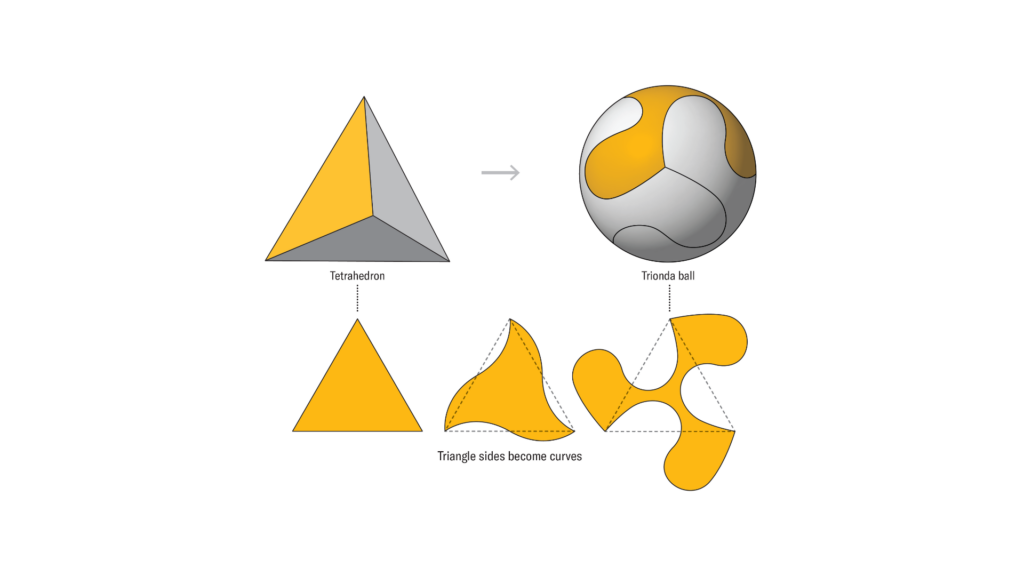
This is governed by Gauss’s Theorema Egregium, which proves that you cannot map a flat surface (Gaussian curvature K = 0) to a sphere (Gaussian curvature K > 0) without stretching, tearing, or wrinkling the material.
But this isn’t the first time FIFA have experimented with the tetrahedron. In 2010, the official match ball for the FIFA World Cup was the controversial Jabulani. A product made by Adidas, it was one of the smoothest and roundest balls to be created by them. But this caused problems as its extremely smooth surface altered the drag forces acting on it, making shots and passes harder to predict.
So, for the 2026 ball, designers decided to add divots and long winding seams to introduce the correct amount of roughness. However, this could lead to problems in symmetry, which in turn could generate uneven drag, causing the ball to wobble or drift unexpectedly.
The maths behind FIFA rankings and World Cup seeding
Since August 2018, a method known as the ‘SUM METHOD’ has been used to calculate FIFA rankings. It involves 4 things:
- The Relative Strength of the two teams (Must be a FIFA sanctioned international match)
- The Importance of the game
- The Result
- The Expected Result
FIFA created a formula that integrates these 4 factors into its calculations:
This formula states that , the number of ranking points for a team before the game, is equal to the team’s total ranking points before the game () plus the importance of the match () multiplied by the difference between the final result () and the expected result ().
So, if a lower-ranked team won in a match versus a higher-ranked team in a FIFA World Cup Qualifier, they would win more ranking points than if it were a friendly.
Likewise, if the higher-ranked team won against the lower-ranked team, they would receive fewer ranking points as they were expected to win.
Well, how do rankings impact seeding and groups in World Cups?
These rankings are converted into seeds. The higher-ranked teams receive a lower seed number, and the lower-ranked teams receive a higher seed number. These seed numbers are split into 4 groups called pots. Pot 1 will contain the host nations and the best teams (lowest seeded), whereas Pot 4 will contain the worst teams (highest seeded). To form groups, officials will pick one team from each pot to form a group. This is not random, as FIFA must follow other geographical rules for fairness.
That is some of the maths behind the World Cup! So, the next time you watch a World Cup match, or even better, any football match, you’ll be one of the few to know the maths and work behind the scenes!