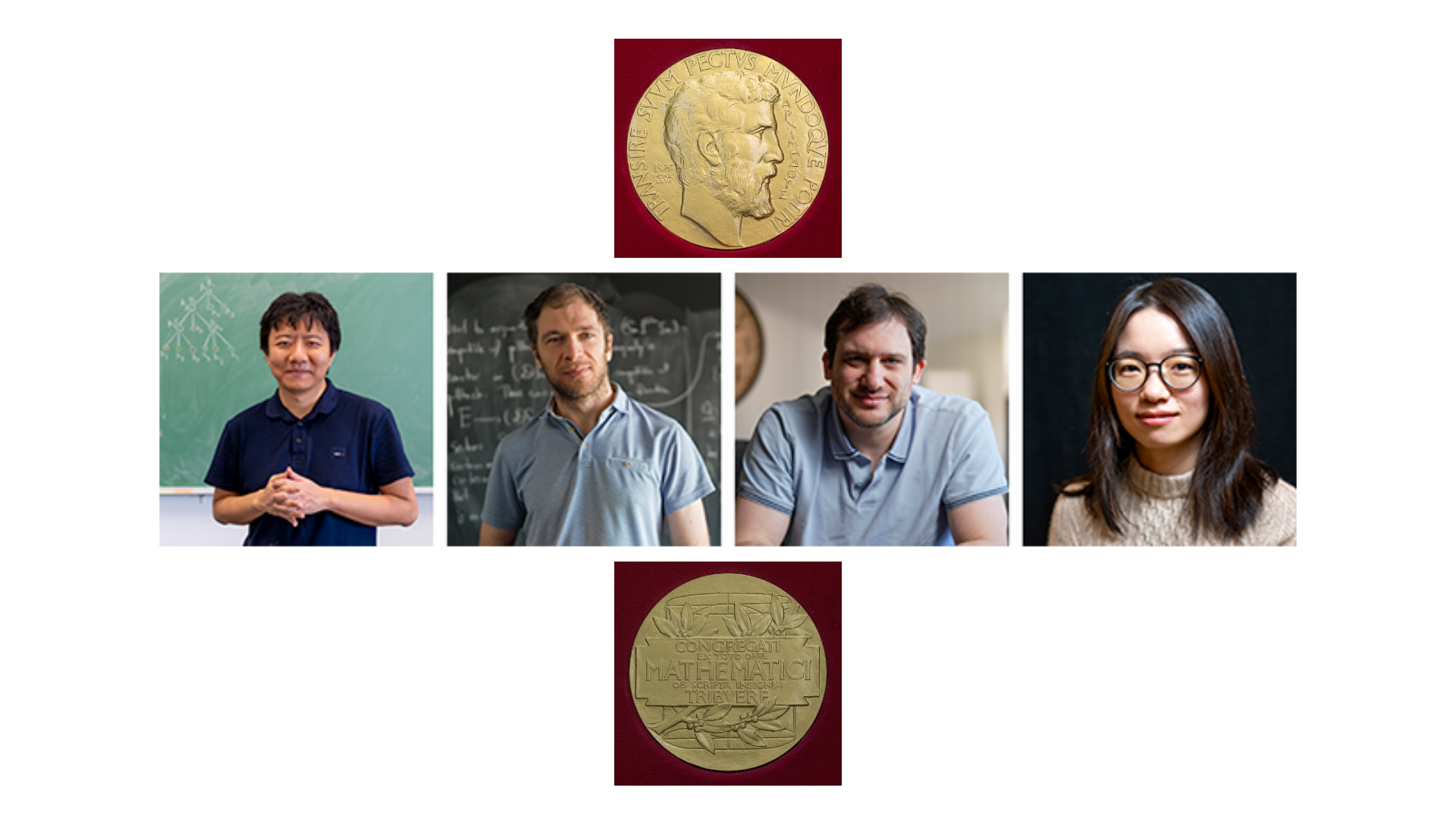
Established in 1936 by Canadian mathematician John Charles Fields, the Fields Medal is widely regarded as the highest honour in mathematics. At the 2026 International Congress of Mathematicians in Philadelphia, medals were awarded to Hong Wang of New York University and Institut des Hautes Études Scientifiques, Yu Deng of the University of Chicago, John Pardon of Stony Brook, and Jacob Tsimerman of University of Toronto. Conferred every four years by the International Mathematical Union, the prize recognises extraordinary achievement while encouraging future discovery.
Similarly to the annual Abel Prize, the Fields Medal makes up for the lack of a Nobel Prize in mathematics. However, unlike the Nobel Prizes, recipients must be under 40 years old by the start of the award year, forcing the committee to honour researchers who have not only resolved monumental open problems, but who are actively shaping the future of the field.
This year’s cohort represents a striking international blend of institutions and global origins, spanning geometry, wave mechanics, physics-inspired mathematics, and mathematical logic. Most notably, the ceremony marked a profound milestone for representation in higher mathematics. Professor Hong Wang became only the third woman in history to receive the Fields Medal, joining Maryam Mirzakhani from 2014 and Maryna Viazovska in 2022.
The core problem that established Wang’s groundbreaking work traces back to 1917, when Soichi Kakeya asked a surprisingly simple question: what is the smallest possible area needed to fully turn a needle around 360 degrees? While you might picture a neat circle, mathematicians discovered that by cutting and overlapping tiny pieces of the shape, you can build a region – called a Kakeya set – that contains a needle pointing in every possible direction, yet takes up an arbitrarily tiny amount of actual space. This led to the famous Kakeya Conjecture, which suggested that even if these shapes have almost zero volume, their underlying geometric structure must still be ‘thick’ enough to span the full dimensions of the space they live in.
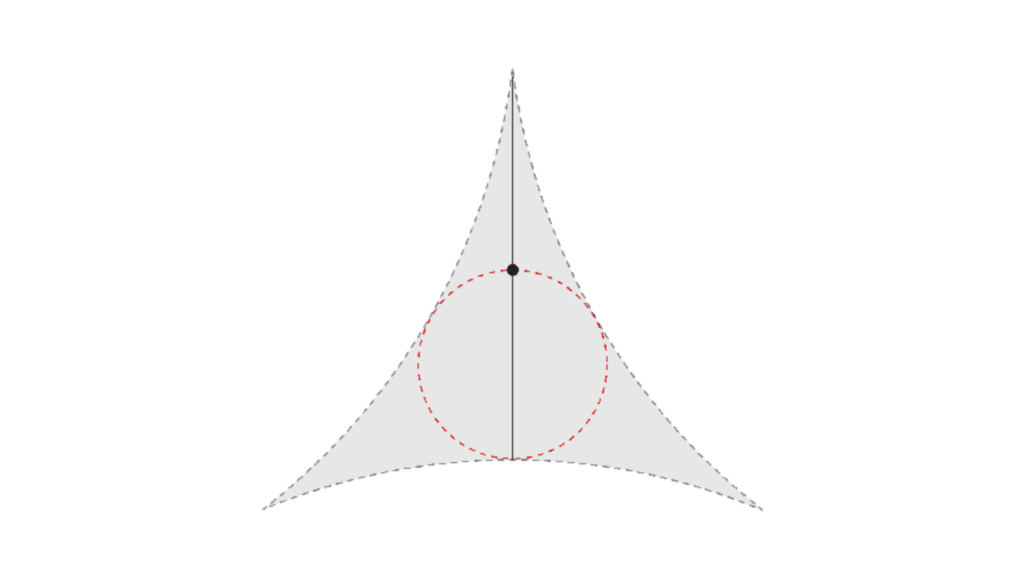
In a landmark achievement, Hong Wang solved the three-dimensional Kakeya Conjecture, resolving a challenge that had stumped leading mathematicians for nearly half a century. Rather than looking at thin line segments in isolation, Wang studied how overlapping 3D tubes interact when pointed in different directions. She proved mathematically that lines facing different ways cannot be squished together tightly enough to collapse the space, forcing the structure to fill out a full three dimensions. Beyond this needle problem, Wang’s geometric insights have helped explain how light and sound waves spread out and overlap in physical space.
The broader 2026 medallist cohort underscores how modern mathematical breakthroughs increasingly occur at the intersections of distinct fields. Yu Deng made historic progress on bridging the gap between microscopic particle collisions and macroscopic fluid flow, like that of water or air. John Pardon advanced geometry by counting curved surfaces inside complex shapes used in theoretical physics and string theory. Meanwhile, Jacob Tsimerman used tools from pure mathematical logic to solve long-standing problems about geometric shapes in high dimensions. Together with Wang’s achievements, the 2026 awards demonstrate that century-old challenges are falling to fresh, creative methods, while setting an inspiring precedent for international diversity in higher mathematics.