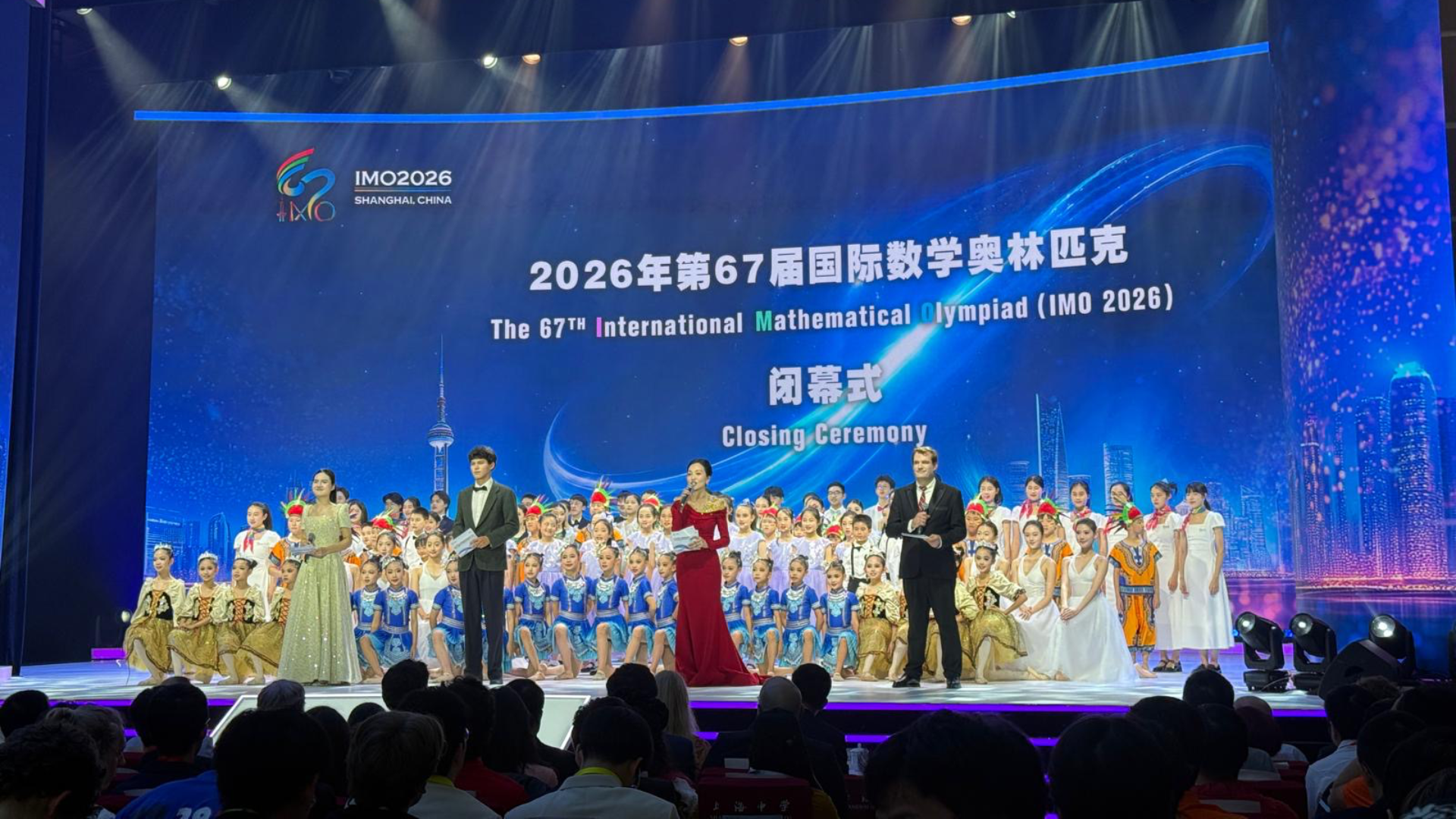
China topped the medal table at the 67th International Mathematical Olympiad, the premier annual world maths championship for high school students, which this year was held in Shanghai. Seven students achieved a perfect score a 42 – and for the first time, an AI model was judged to have taken a clean sweep as well.
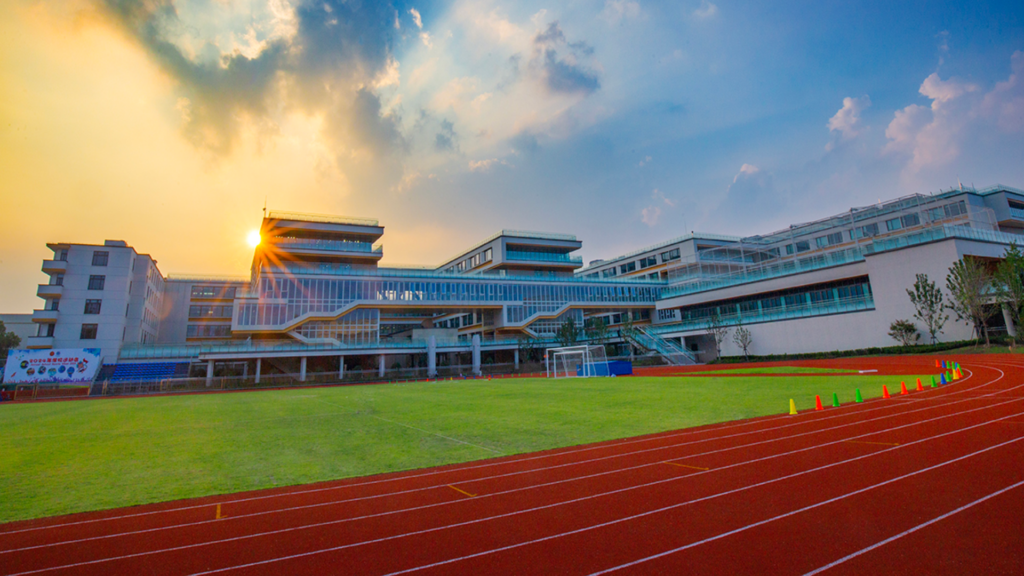
The competition, which featured 666 contestants from 117 different countries and territories, was hosted at the impressive Shanghai High School and co-organised by the Chinese Mathematical Society and Shanghai Municipal Education Commission. The Olympiad’s goal is to celebrate the brightest and most talented high school maths students, aiming to inspire and challenge them, help young mathematicians connect, and encourage the sharing of ideas about how maths is taught in schools. Above all, the competition aims to build a wider appreciation of mathematics across the globe.
At each Olympiad, countries bring a team of up to six pre-university students to solve 6 tricky problems from secondary school mathematics, requiring expert insight and creativity, over nine hours split between two consecutive days. Each problem is worth 7 points, with a maximum total of 42 points available. Calculators are not permitted and the responses must include complete proofs and justifications. The problems build on difficulty over the day, with problems 3 and 6 traditionally being the hardest. Problems are chosen by an IMO Jury formed from the competing teams, and come from various areas of high school maths, including algebra, combinatorics, geometry, and number theory. You can even attempt the questions from the 2026 edition yourself here!
Alongside the competitive aspect, students have had the opportunity to attend lectures from eminent mathematicians, workshops on Chinese culture, and recreational activities such as gaming, swimming, and watching the World Cup Final. Tours of Shanghai also gave contestants experiences bridging culture, nature and technology, including visits to Shanghai Disneyland, Shanghai Greenhouse Garden, and the Shanghai Science and Technology Museum. Above all, they also got the chance to get to know each other and make friends with maths enthusiasts from across the world.
The competition’s participation has grown massively from the seven Eastern European nations that took part at the first Olympiad in Romania in 1959, with over a hundred countries and territories from across the world competing this year.
Around half of participants receive medals, with Bronze, Silver, and Gold medals being awarded in a roughly 3:2:1 ratio. Honourable mentions are given to students who obtain a full solution on at least one problem without being awarded a medal. Every year The Mirzakhani Prize is given to the highest-scoring female contestant from five regions.
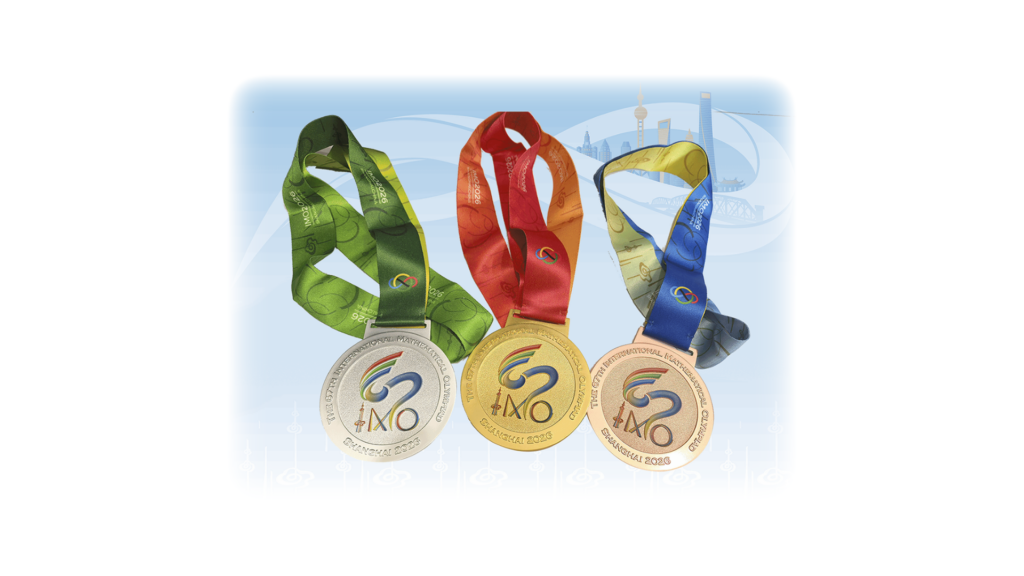
In Shanghai this year, seven students achieved perfect scores, 55 students won Gold, 105 won Silver, 189 won Bronze, and a further 141 were awarded Honourable Mentions. They received their awards on stage at the Closing Ceremony, held at the Auditorium of Shanghai High School.
The results
Top countries
| # | Country | Pts | G | S | B | HM |
|---|---|---|---|---|---|---|
| 1 | 🇨🇳 People’s Republic of China | 232 | 6 | |||
| 2 | 🇺🇸 United States of America | 207 | 4 | 1 | 1 | |
| 3 | 🇷🇺 Russian Federation | 196 | 4 | 2 | ||
| 4 | 🇸🇬 Singapore | 169 | 3 | 2 | 1 | |
| 5 | 🇻🇳 Vietnam | 168 | 2 | 3 | 1 | |
| 6 | 🇰🇷 Republic of Korea | 167 | 3 | 2 | 1 | |
| 7 | 🇮🇳 India | 166 | 2 | 4 | ||
| 8 | 🇰🇵 Democratic People’s Republic of Korea | 163 | 2 | 2 | 2 | |
| 8 | 🇬🇧 United Kingdom | 163 | 2 | 1 | 3 | |
| 10 | 🇯🇵 Japan | 159 | 2 | 1 | 3 |
China’s team continued its run as the most successful nation in Olympiad history, topping the medal table for the 26th time on home soil. All six members of the Chinese team won gold medals, three of whom attended Shanghai High School, the host venue for the competition. This also marks China’s eighth consecutive year with one competitor netting a perfect score – three, in fact, managed the feat this year.
25 points further back, the United States finished second on the medal table, another strong result for one of the Olympiad’s strongest countries. Seven of the top 10 countries on the medal table were from Asia, with Singapore’s fourth place particularly impressive for such a relatively small city state. Russia, whose competitions were once again allowed to compete under their national flag this year, and the United Kingdom were the strongest European countries in the competition. India secured its fourth consecutive year in the global top 10, and for the first time its team included two female competitors.
Brazil also scored strongly, ranked 11th with 155 points, the highest score for a Latin American country. Further down the table, Malaysia achieved its best-ever result by reaching the top 20, tying with Olympiad heavyweights Bulgaria and Germany. Saudi Arabia also delivered its record performance, with all participants taking home medals for the first time.
South Africa retained its position as the highest-scoring African nation, placing 57th globally with 94 points. Morocco and Rwanda maintained their status as strong African Olympiad competitors, and Uganda secured a breakthrough performance, pooling a record 31 points.
Top individuals
| # | Contestant | Country | Pts |
|---|---|---|---|
| 1 | Leyan Deng | 🇨🇳 People’s Republic of China | 42 |
| 1 | Che Liu | 🇨🇳 People’s Republic of China | 42 |
| 1 | Bolun Zhang | 🇨🇳 People’s Republic of China | 42 |
| 1 | Hyeonjun Lee | 🇰🇷 Republic of Korea | 42 |
| 1 | Alex Chui | 🇬🇧 United Kingdom | 42 |
| 1 | Liam Reddy | 🇺🇸 United States of America | 42 |
| 1 | Alexander Wang | 🇺🇸 United States of America | 42 |
| 8 | Arina Prokudina | 🇷🇺 Russian Federation | 41 |
| 9 | Andrey Shishko | 🇷🇺 Russian Federation | 39 |
| 9 | Boyang Brian Xao | 🇸🇬 Singapore | 39 |
| 9 | Ruilin Wang | 🇺🇸 United States of America | 39 |
Seven students obtained perfect scores, not quite a record but still a very impressive display. Three Chinese students, all of whom attend the host institution Shanghai High School, two American students, Hyeonjun Lee from South Korea and British student Alex Chui achieved the feat.
Alex, who is in Year 13 at Tonbridge School, earned his fifth Olympiad Gold medal, which along with two previous Silver medals make him the most successful participant in the history of the competition. Alex rounds off his final Olympiad, before starting university, with a perfect score.
Funnily, three of the seven perfect-scoring individuals sat within four desks of each other inside the examination hall, sparking playful theories around ‘genius radiation’.
Recipients of The Mirzakhani Award
| # | Contestant | Country | Pts |
|---|---|---|---|
| 8 | Arina Prokudina | 🇷🇺 Russian Federation | 41 |
| 40 | Amber Yanfei Li | 🇦🇺 Australia | 29 |
| 205 | Anu Altangerei | 🇲🇳 Mongolia | 21 |
| 350 | Andrea Sarahí Cascante Duarte | 🇲🇽 Mexico | 15 |
| 530 | Lightness Pigiliano Ngiliule | 🇹🇿 Tanzania | 8 |
The Mirzakhani Award is given to the highest-scoring female competitors from 5 global regions. It is named in honour of Maryam Mirzakhani, the first woman to win the prestigious Fields Medal.
Arina Prokudina was the highest-scoring young woman in the competition, netting 41 points, placing her in the top 10 individuals worldwide. She also achieved the highest score of all of the Russian participants, making her the European winner of The Mirzakhani Award.
The Oceanian winner of the Award, Australian Amber Yanfei Li, was also the highest-scoring competitor on her national team.
The Asian winner of the Award was Anu Altangerei of Mongolia. It is worth noting that Indians Sanjana Philo Chacko, with 25 points and Shreya Shantanu Mundhada, with 24 points, scored higher, but India is classified as part of the Oceanian region for Olympiad purposes.
The winner of the Award from the Americas was Mexican Andrea Sarahí Cascante Duarte, and the winner from Africa was Lightness Pigiliano Ngiliule of Tanzania.
AI at the Olympiad
A new AI model from Chinese social media giant RedNote became the first Large Language Model to achieve a perfect score at the Olympiad. The South China Morning Post reported that “the model, dots-note-3.0, solved all six puzzles and secured a perfect score of 42 at this year’s IMO.
“The note variant, still in beta phase, is currently the lightest model in the dots3 family, which includes two larger versions – jazz and aria – tailored for different use cases and compute costs. Shanghai-based RedNote, known for its Instagram-style social community called Xiaohongshu in Chinese, said it would open-source dots-note-3.0 “in the near future”, without providing further details, according to a post on the model’s website.”
OpenAI’s ChatGPT 5.6 Pro also solved all 6 problems on its first attempt without any human help or steering.
These breakthroughs are particularly impressive as Olympiad problem responses require proofs backed up by rigorous arguments, without logical errors or missing conditions, and are judged by expert panels. Only a few years ago Large Language Models struggled with basic word problems for 12-year-olds – now they can match the brightest young mathematicians on the planet. It will be exciting to see this technology develop and there could be enormous implications for how mathematicians go about their work in the near future.
The International Mathematical Olympiad has once again demonstrated that mathematics is a genuinely international language and brought together hundreds of the world’s brightest young mathematicians. Congratulations to all of the contestants for their remarkable achievements, particularly to the medal and prize recipients, as well as to all of the organisers, volunteers, team leaders and co-ordinators who made the event possible.
The Olympiad will return next year for its 68th running in the beautiful and historic city of Budapest, Hungary.