Fractals are some of the most interesting patterns in mathematics, and possibly all of existence. They are never-ending and infinitely complex, and look roughly the same no matter how far you zoom in. From snowflakes to fern leaves, you are bound to have encountered these incredible structures.
What are Fractals?
Fractals are complex geometric shapes made from never-ending patterns that repeat themselves at different scales. This property is known as ‘self-similarity’. Although fractals are very complex, they are made by repeating a simple process. Fractals are typically created by repeating a simple process over and over in an ongoing feedback loop. These patterns are infinitely complex and intricate, and we can zoom in or out on them forever while they still appear similar.
Mathematical fractals are formed by calculating a simple equation thousands of times and feeding the answer back into the start. These are known as recursive algorithms. The patterns formed can have non-integer dimensions, differentiating them from traditional geometric shapes.
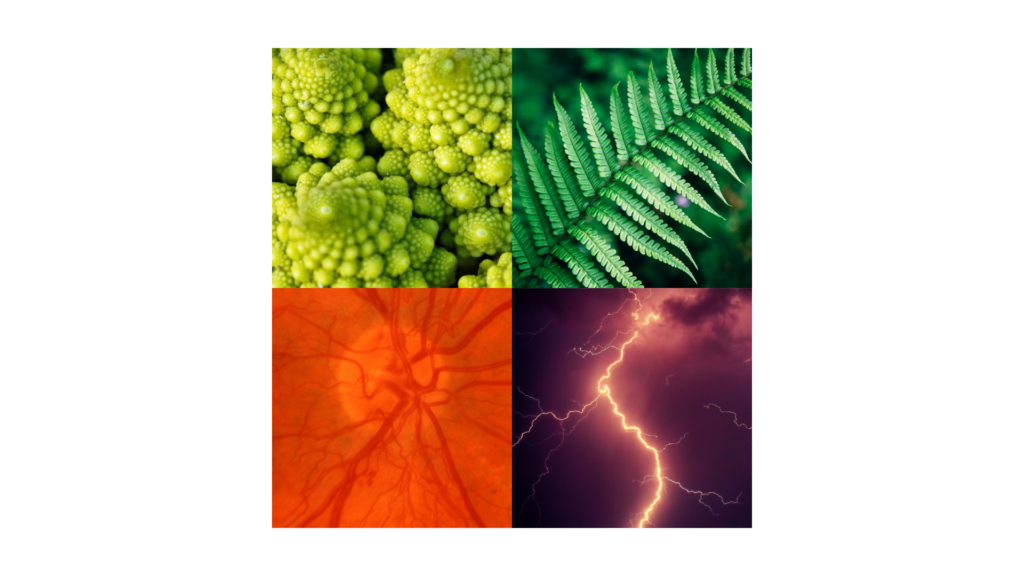
There are beautiful examples of fractal shapes in nature, like fern and romanesco broccoli plants. Ferns consist of many small leaves branching off a larger one. Romanescos consist of smaller cones spiralling around a larger one. Tree branches, river networks, blood vessels, and lightning bolts also exhibit self-similarity. These natural fractals are not perfectly infinite like the mathematical structures but repeat at many orders of magnitude.
Fractals have captured the inspiration and attention of mathematicians, artists, and scientists alike for their both their beautiful and mind-bending properties.
Building fractals
To create a fractal, you start with a simple pattern and then repeat it continuously at smaller scales. A simple pattern may be a line segment, with two more segments branching off one end. If the pattern is repeated, both of these segments will have two further branches at their ends. Depending on the position of the branches, you can make different patterns whether a tree, a fern, or a set of pentagons.
Sierpinski Triangle
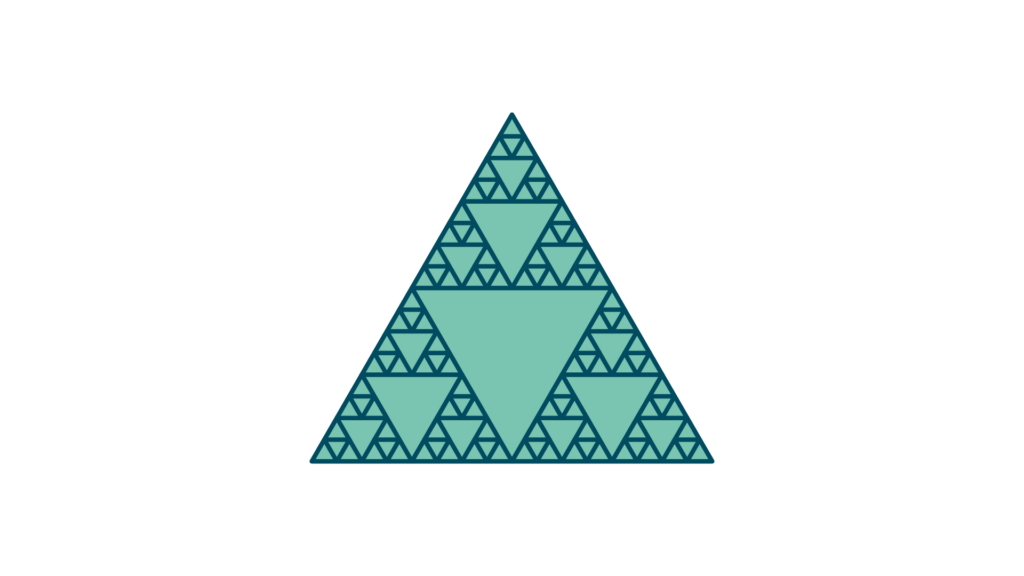
A famous fractal is the Sierpinski Triangle. This figure is made starting with a large equilateral triangle. Smaller equilateral triangles are repeatedly cut out of the remaining parts. The final shape is made up of three identical copies of itself, each consisting of even smaller copies of the whole triangle. No matter how far you zoom in on the triangle, the pattern would continue repeating forever. The figure is named after Polish mathematician Waclaw Sierpinski, the first to think about the properties of this triangle, but it has appeared many centuries earlier in artwork and mosaics
One of the key properties of fractals is that when you ‘zoom in’ on them forever you can always find new patterns. Around 1920, British mathematician Lewis Fry Richardson realised that the same is true for the coastlines of countries. You start with a basic shape, and as you zoom in, you add estuaries, headlands, bays, then individual cliffs, rocks, pebbles, and so on. If you get more and more precise with your measurement of a coastline, the result does not become more accurate. It simply becomes larger. It seems like all coastlines are infinitely long. This is known as the coastline paradox.
Koch Snowflake
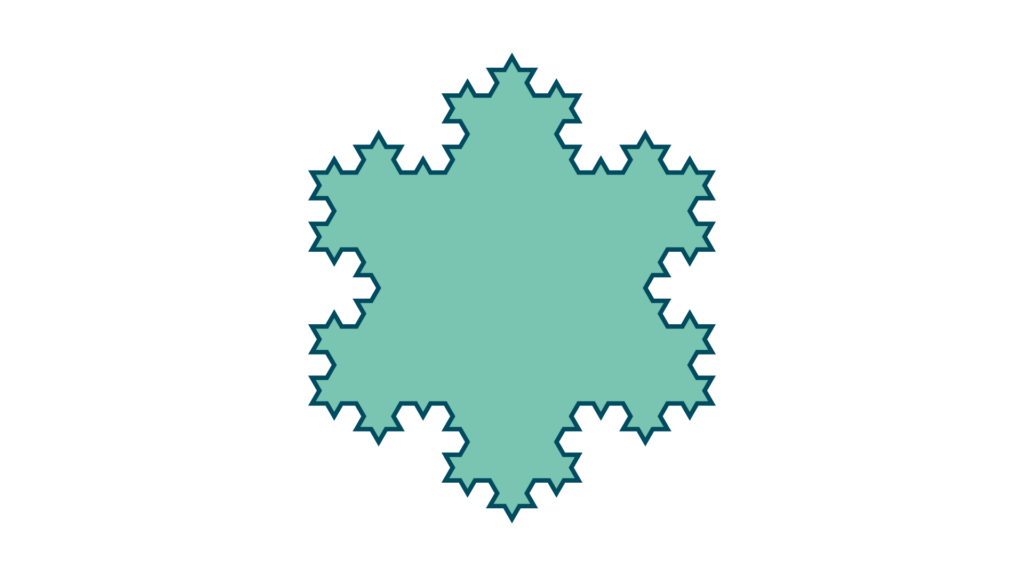
Other great examples of fractal shapes in nature are snowflakes and ice crystals. And, we have an example of a fractal snowflake devised by Swedish mathematician Helge von Koch. To create it, once more we have to find a simple procedure to apply over and over again. Like with a Sierpinski triangle, we start with a single equilateral triangle, but instead of removing smaller triangles at every step, we add smaller triangles along the edge. Each triangle added to the middle of each side has one third the side length of the triangle from the previous step. Once again, you will see the smaller sections of the edge of the snowflake look exactly the same as the larger sections.
The Koch snowflake has a finite area but an infinite perimeter.
Fractals can also be three-dimensional, like the Menger sponge, formed from a solid cube with ever-diminishing holes drilled into each side.
Fractal dimensions
While many fractals are self-similar, a better definition is that fractals are shapes which have a non-integer dimension.
A line has a dimension of 1. When scaling it by a factor of 2, its length increases by a factor of 21 = 2. A square has dimension 2, so when it is scaled by a factor of 2, its area increases by a factor of 22 = 4. A cube has dimension 3. When scaling it by a factor of 2, its volume increases by a factor of 23 = 8 – the larger cube consists of eight copies of the smaller one.
It you scale the Sierpinski triangle by a factor of 2, its ‘area’ increases by a factor of 3. If d is the dimension of the Sierpinski triangle, using the same pattern, the 2d = 3. In other words, d = log2(3), which is equal to roughly 1.585. The Sierpinski triangle is something in between a 2D area and a 1D line.
How can something have a dimension that is not an integer? This is one of the weird properties of fractals – and it gives them their name – they have a fractional dimension.
Mandelbrot Set
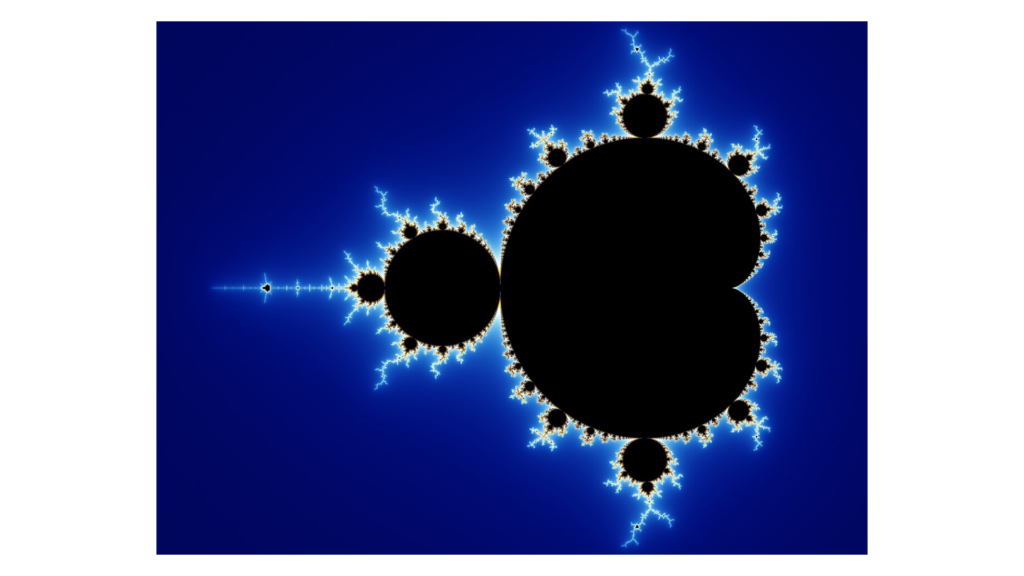
The Mandelbrot set is a famous mathematical shape generated by repeating a simple formula over and over again: taking a number, squaring it, adding a constant, and feeding the result back in. Depending on the constant chosen, this process either stays bounded or spirals off into infinity. The Mandelbrot Set is the collection of all constants for which the process is bounded. When plotted, it produces an infinitely detailed, endlessly complex boundary and one of the most recognisable images in mathematics.
The set is named after Benoit B. Mandelbrot, a mathematician working at IBM’s Thomas J. Watson Research Center, who began producing computer-generated images of it in late 1979.
Real-world uses
Fractals have applications in fields like medicine, biology, geology, and meteorology. We can also use fractals to create realistic copies of nature, for example the landscapes and textures in video games and computer-generated graphics in films. Water, mountains and clouds can all be made in a computerised world with the help of fractals. We can even reverse the process to compress digital images to reduce their file size.
You will surely see fractals all over the place now! From their extraordinary mathematical properties to their beautiful examples in nature and architecture, there is something quite incredible about these never-ending patterns.