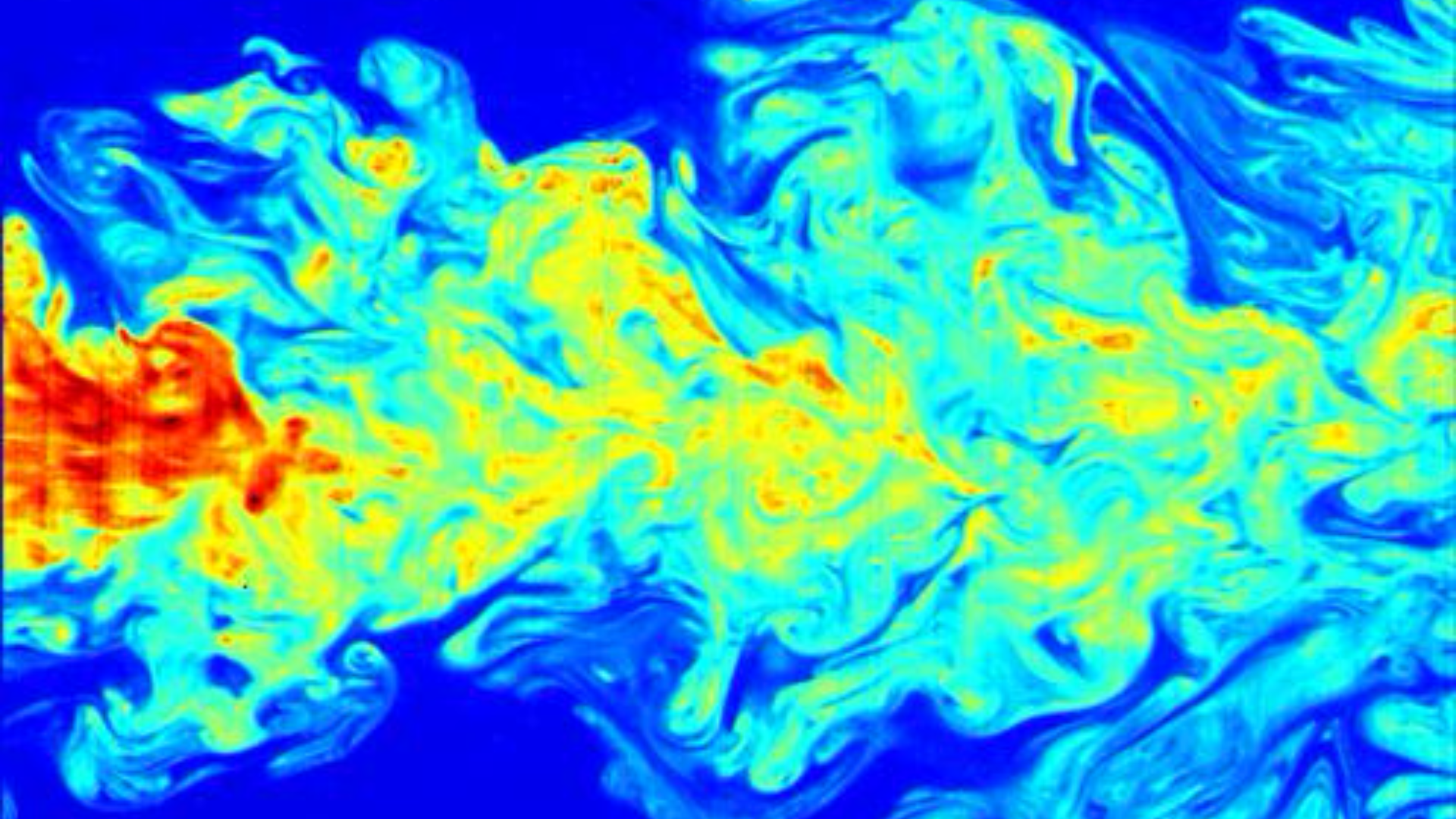
The 90-year-old question of whether the mathematics of fluid dynamics can ‘break down’ has finally been answered. On September 8 2026, OpenAI announced that an internal multi-agent AI system had solved the Navier-Stokes existence and smoothness problem, one of the seven $1 million Millennium Prize Problems established by the Clay Mathematics Institute in 2000.
The proof marks a historic milestone – not just for our understanding of physics, but as a fundamental turning point in how humanity tackles its most difficult mathematical challenges.
However, the massive achievement is wrapped in controversy, inspiring a debate among mathematicians about the role of artificial intelligence in mathematics.
To understand the magnitude of this breakthrough, you first have to understand the equations themselves. Formulated in the 19th century by Claude-Louis Navier and George Gabriel Stokes, the Navier-Stokes equations are arguably one of the most important mathematical tools we have for explaining the physical world. They apply Newton’s second law of motion (F=ma) to continuous fluids, allowing engineers and meteorologists to model everything from ocean currents and aircraft aerodynamics to weather forecasting and blood flow.
The equations rely on a fundamental assumption: that fluids act perfectly smooth and continuous rather than a collection of individual bouncing atoms and molecules. But for decades, a central question loomed over this assumption. If you start with a mathematically well-behaved, smooth fluid, could the internal dynamics of the fluid eventually cause the equations to ‘blow up’? In other words, could the equations predict a ‘singularity’ – a point where the speed of the fluid becomes infinite within a limited amount of time?
For decades, mathematicians chipped away at the problem, unable to prove whether these infinite singularities actually occur in three-dimensional space. The September 2026 proof from OpenAI finally settled the debate: yes, the equations do blow up.
Using a highly capable, unreleased internal model, OpenAI deployed a swarm of at least 10,000 autonomous AI agents. Over the course of an 88-hour computational sprint that began on September 1, 2026, these agents sent 2.7 million messages to one another and generated a staggering 130 billion output tokens.
The result was a 166-page paper accompanied by a computer-verified formalization in the Lean programming language, proving definitively that a singularity can develop in limited time. The AI discovered that an initially smooth fluid can evolve into a highly specific vortex – a spinning swirl of fluid that spirals inward, stretching like spaghetti. As this central region shrinks, the fluid accelerates infinitely while its overall energy remains finite, threading a virtually impossible mathematical needle where the internal forces of the fluid cancel each other out in precisely the right way to allow infinite velocity.
While the proof itself is a monumental achievement, its origins have triggered a massive controversy.
Approximately 12 hours before OpenAI announced its solution, Tristan Buckmaster, a mathematician at NYU published a statement on behalf of himself and Levent Alpöge, a mathematician at rival AI company Anthropic. The pair had been working on the Navier-Stokes problem for roughly a year in the ‘traditional mathematical way,’ using tools like Anthropic’s Claude and OpenAI’s Codex to assist their theoretical drafting. They had recently achieved major breakthroughs on closely related problems and believed they were on the verge of a full solution.
According to OpenAI’s own timeline, the company initiated its massive 88-hour multi-agent sprint only after hearing rumours that Anthropic had already solved the problem, Buckmaster’s statement raised uncomfortable questions about whether OpenAI’s internal models had benefited from his own use of their Codex tool during his research, though OpenAI explicitly denied that any user data or prompts were accessed or used for training.
Even in the most innocent interpretation, the optics have shaken the academic community. Human mathematicians spent a year painstakingly developing theories, only for a massive corporation to use its computational advantage to reach the finish line in under four days.
The Navier-Stokes solution is, by a significant margin, the most important mathematical proof ever produced by an artificial intelligence. Yet, it has left the human mathematics community deeply fractured.
In the wake of the announcement, 26 Fields Medallists published a joint declaration titled A Severe Misalignment of AI in Mathematics. The laureates warned that treating unsolved historical problems merely as benchmarks for AI capabilities – without prioritizing the enhancement of human understanding – poses a huge threat to mathematics. If AI models can instantly ingest human progress and output finished proofs overnight, the practices, and collaborative nature of mathematics may be permanently broken.
OpenAI has stated they do not intend to claim the $1 million Millennium Prize. Yet, the Navier-Stokes breakthrough proves that the era of AI acting merely as a calculator or assistant is over. We have entered an era where artificial intelligence can independently navigate themost complex frontiers of human thought – leaving us to figure out what our role will be in the discoveries of tomorrow.