Maryam Mirzakhani
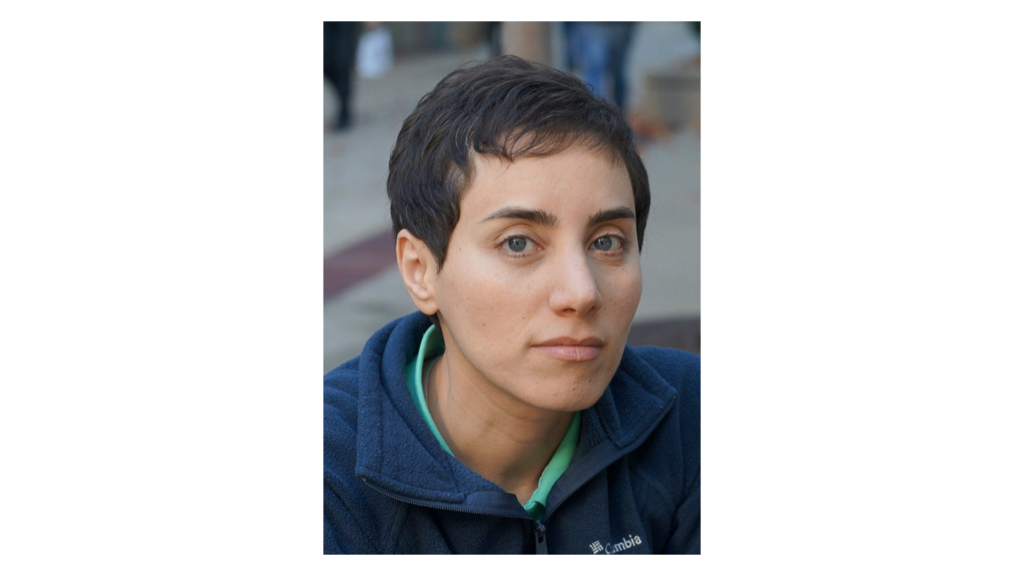
Maryam Mirzakhani (1977–2017) born in 1977 in Tehran, Iran, is one of the world’s greatest female mathematicians. She revolutionised geometry, topology and dynamics, becoming the first woman and first Iranian to receive the Fields Medal, the highest prize in mathematics.
Early life
Maryam grew up in the Iranian capital Tehran during the brutal Iran-Iraq war, which meant resources available to her family were limited. Still, she preserved through sheer curiosity. As a child, she didn’t dream of becoming a mathematician. She actually wanted to be a writer. But at school, one of her teachers entered her into a maths competition. There she learned she was good at it. Really good. She went on to win two gold medals at the International Mathematical Olympiad (IMO), in 1994 and 1995, the first Iranian woman to do so. In her second year, she achieved a perfect score.
She later earned her PhD from Harvard University, where her advisor immediately recognised that she on a totally different level.
Career and achievements
In 2014, she was awarded the Fields Medal at the International Congress of Mathematicians. This award is thought of as like a “Nobel Prize of Mathematics.” She was the first woman to receive it, the first Muslim, the first Iranian, and one of the few geometers ever honoured this way.
At the time, she was a professor at Stanford University. Her work helped answer questions about the geometry of Riemann surfaces and moduli spaces. She helped develop concepts that influence physics, chaos theory, and even string theory.
Maryam hated fast solutions. She preferred to struggle with problems for months, even years, covering sheets of paper with diagrams and drawings. Despite being world-famous she remained extremely humble and private.
Once, Maryam was on the floor of her office drawing on a huge piece of paper. When her colleague walked in, they thought she was drawing abstract art. It turned out each drawing represented a geometrical structure. Maryam said maths was about patience. Sometimes you spend years without making progress. But slowly, patterns begin to appear. That patience separated her from everyone else.
Legacy
Maryam Mirzakhani changed maths irreversibly. She proved that brilliance doesn’t always have to be loud and flashy, like a light bulb above your head. It can be quiet, consistent and deeply imaginative.
She passed away in 2017 at just 40 years old, after a four-year-long battle with cancer. The loss was huge for the whole world. But her legacy remains powerful. She opened doors for women in mathematics, reshaped modern geometry, and showed that creativity and logic are not opposites, but powerful partners.
Despite her tough life, from her upbringing in wartime Iran to her last few years fighting cancer. Maryam Mirzakhani proved everyone has huge potential and with a handful of curiosity and patience, you can achieve anything.