Thales of Miletus
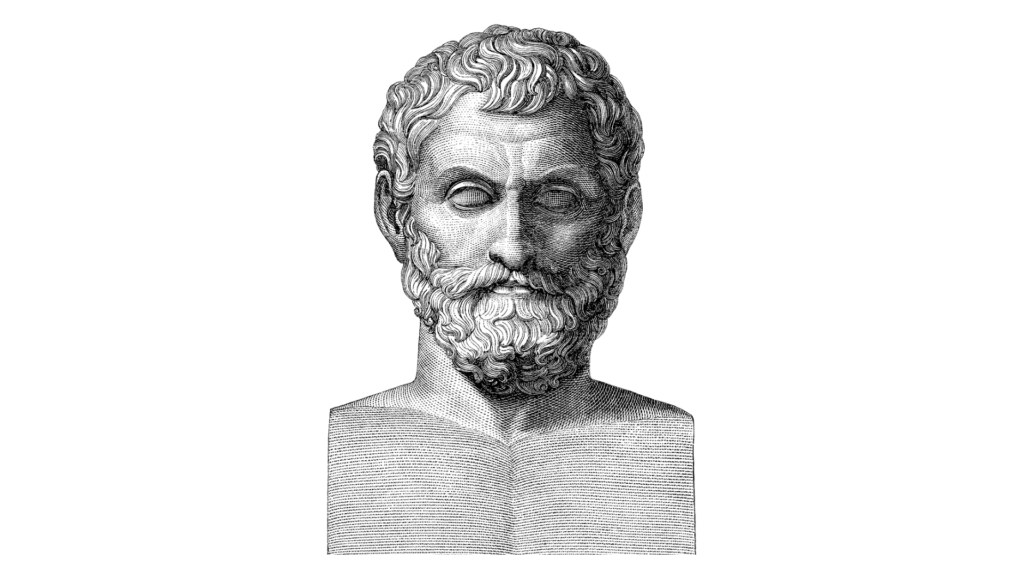
Thales of Miletus (c.624-620–c.548-545 BCE) was a great philosopher and mathematician from Ancient Greece, with the wherewithal to stop wars and redefine existence with the power of maths and reason.
Introduction
Ancient Greek philosopher and mathematician Thales was born around 624 BCE in the bustling Ionian city of Miletus. Having a big city come after your name just sounds a whole lot better than a normal surname! He is fabled to be renowned as one of the legendary seven Wise Men of antiquity.
Early life
Not unlike many of his fellow ancient Greek philosophers, very little is actually known about Thales’s early life. No pieces of his writing actually survived, which can make it pretty difficult to get a scope of his achievements.
His curiosity wasn’t limited to philosophy – Thales was a polymath-in-the-making, dabbling in geometry, astronomy, and engineering even before adulthood. If he was alive today, he would be the sort of person who would love LEGO.
Career
It didn’t take long for Thales to become a recognised ambassador and advisor in his city, as well as within wider Greece. He famously predicted a solar eclipse in 585 BCE, a feat that astonished contemporaries and secured his reputation as both philosopher and scientist. It also somehow ended up stopping a battle between two local kings.
One account suggests he was a businessman who became rich by predicting weather during the olive harvest.
Achievements
Thales’s legacy is monumental despite the fact we know nothing about his work. He is credited with laying the foundation for natural philosophy, proposing that water is the fundamental substance underlying all matter, or at least according to the word of Aristotle. Essentially, Thales demonstrated that the universe could be understood, without using all those old stories about Zeus and Poseidon creating storms and the sort. He also claimed that magnetic objects contained souls as they could move iron. This crowned him the founder of European philosophy.
He has also been credited with five geometric theorems:
- that a circle is bisected by its diameter,
- that angles in a triangle opposite two sides of equal length are equal,
- that opposite angles formed by intersecting straight lines are equal,
- that the angle inscribed inside a semicircle is a right angle, and
- that a triangle is determined if its base and the two angles at the base are given.
Conclusion
In conclusion, Thales of Miletus was more than a thinker. He actually challenged old ideas and by doing so, paved the path for modern science. His mathematical work that is still relevant today, paired with legendary feats such as supposedly stopping a war using pure genius, cements him as one of the greatest philosophers of all time – a Greek geek.