Circle Theorems
Circles are arguably one of the most important shapes, not just in geometry classes, but also in the world around us. Circle theorems are a very important aspect of Euclidean geometry that has everything to do with circles and angles. They help a mess of lines suddenly become something of geometrical beauty.
Here are some of the most common and useful circle theorems:
Circle Theorem 1
A tangent line and a radius will always intersect at 90°.

A tangent is a line that only touches a single point on the circumference of a circle. There is a simple proof for this: The shortest distance between 2 points will always be perpendicular, as any non-perpendicular pathway will result in a right-angled triangle, where the new pathway becomes the hypotenuse, which, as Pythagoras proved over 2500 years ago, is the longest side of the triangle. Therefore, the line that connects the centre of the circle to the point of intersection of the tangent and circumference, the radius, must be perpendicular to the tangent.
Circle Theorem 2
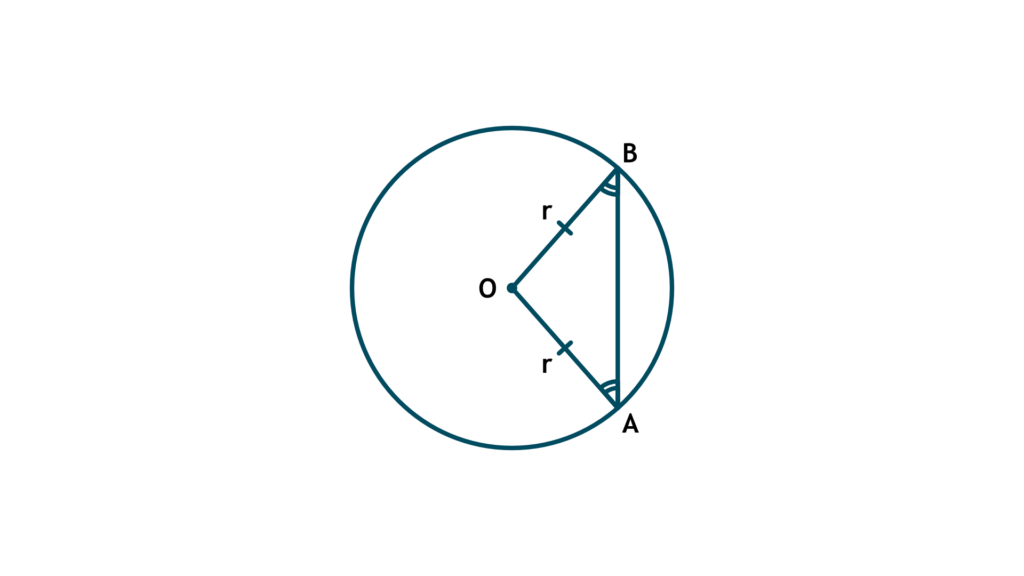
Two radii form an isosceles triangle.
This is rather intuitive, but nonetheless a very important theorem. An isosceles triangle is a triangle that has at least two sides of the same length. Since two of the sides are radii of the same circle, they must also be the same length: . Therefore, it fulfils the requirements for an isosceles triangle.
The Greek mathematician Archimedes calculated an approximation of π by inscribing and circumscribing polygons within circles — a method that laid the foundations for modern calculus over 2000 years later. Archimedes, using 2 96-sided polygons, estimated π to be between 3 and 3 (approximately 3.1408 and 3.1429). That is correct to 3 significant figures, which was an astonishing feat considering it was over 2000 years ago.
Circle Theorem 3
The perpendicular bisector of a chord intersects (passes through) the centre of a circle.
A chord is a straight line that passes through a circle. A perpendicular bisector is a line that passes through a given line segment at its midpoint at 90°. This is not so intuitive, yet its proof is fairly satisfying and easy to follow.
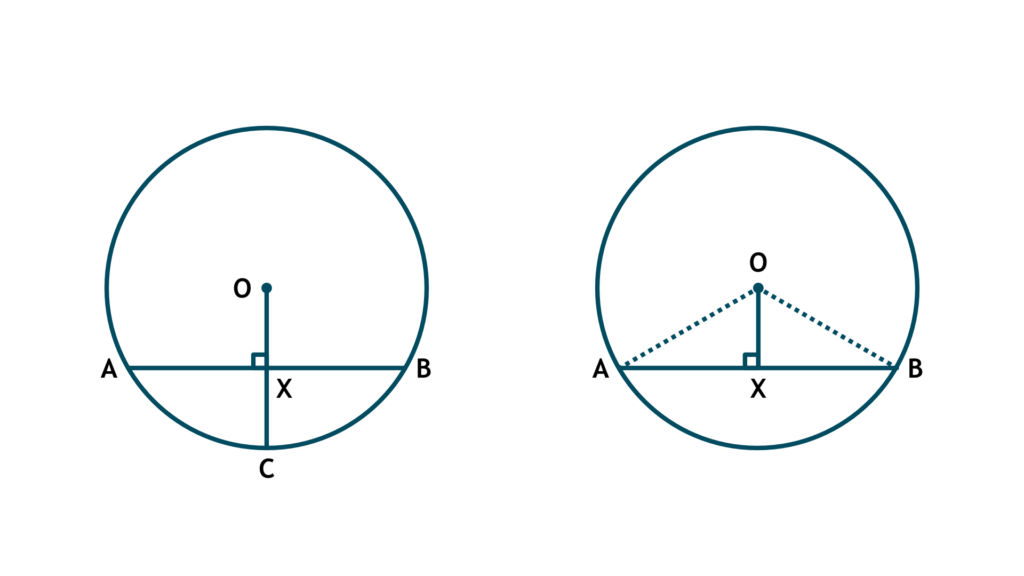
Consider this diagram, where is a chord, and is the perpendicular bisector. Observe the triangles and :
(They are both radii of the circle)
(Since is the midpoint of the chord )
(Shared side)
Therefore, by SSS (side-side-side) congruency, the two triangles are congruent.
It follows that angles and are equal, and since angles on a straight line sum up to 180°, , thus proving the theorem.
Circle Theorem 4
The angle subtended at the centre of the circle is twice the angle subtended at the circumference from the same two points.
“Subtended” just means “formed”.
This theorem sounds a lot more complicated than it really is. Here is a visual representation of the theorem, followed by its proof.
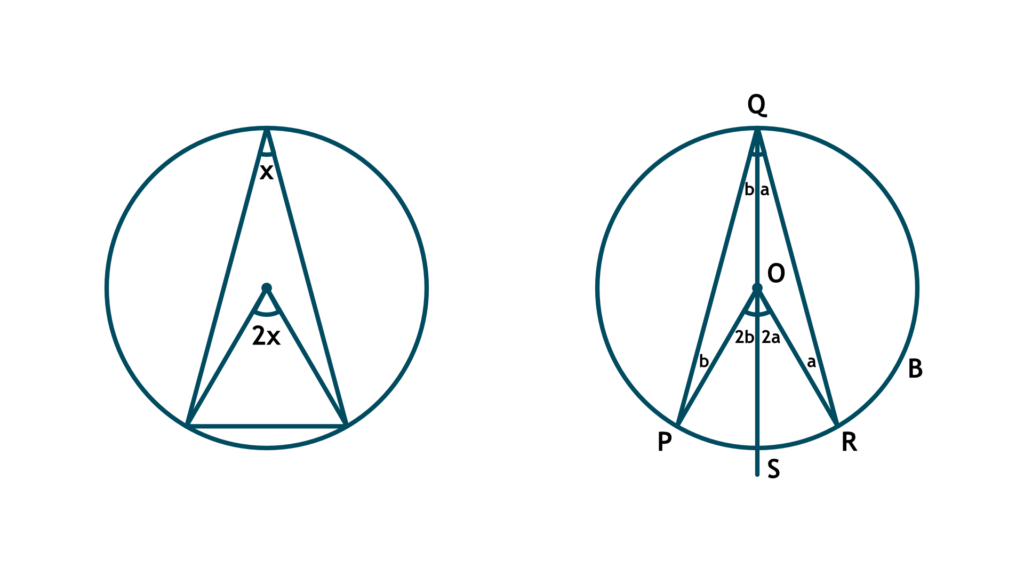
Consider the diagram. Angle is the angle subtended at the centre, and angle is the angle at the circumference. is the diameter of the circle. and .
By the Exterior Angle Theorem, .
A similar argument is applied to angle .
Therefore, and .
It follows that , hence the Theorem.
The German child prodigy Carl Friedrich Gauss requested a 17-sided polygon to be inscribed on his tombstone. At the age of 19, he proved that one could construct a heptadecagon while only using a protractor and a ruler. He did this by proving that could be constructed, as it could be written as a series of nested square roots, which can be constructed by just using a ruler and other basic mathematical principles.
Circle Theorem 5
A triangle drawn from two ends of a diameter will always make a right angle (90°) where it hits the circumference.
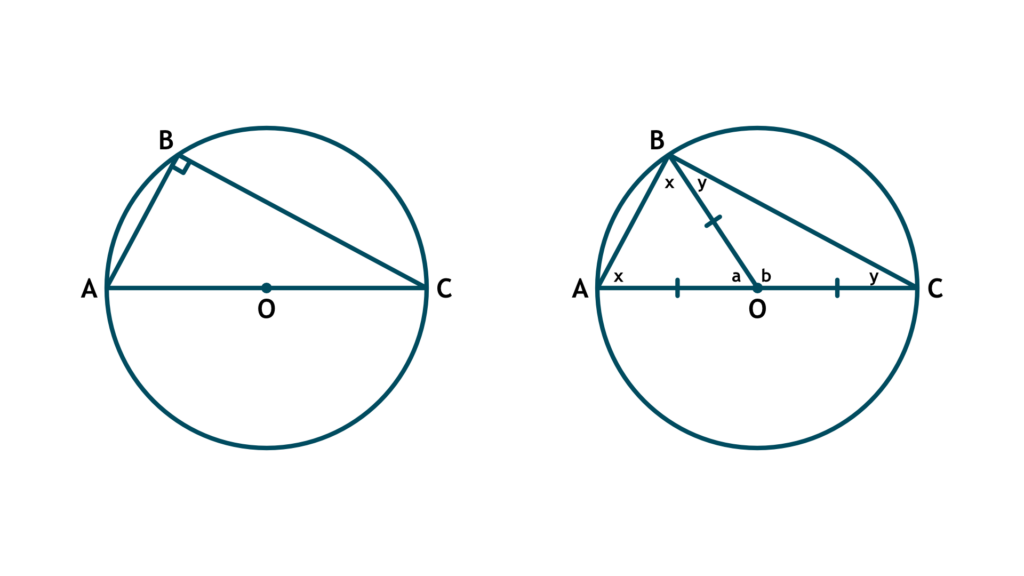
Note the importance of the diameter here, as this does not apply to chords. This is sometimes called Thales’s Theorem. Please note that “Thales Theorem” is something else entirely, but it is something to do with triangles.The theorem can be proved by cutting the triangle ABC into two triangles:
Note that both triangles are isosceles, as each is formed by two radii (Circle Theorem #2).
Since angles on a straight line sum up to 180°, a+b=180. Since angles in a triangle sum up to 180°, a+2x=180, similarly b+2y=180. Therefore, a+b+2x+2y=360 (1)
However, we have established that a+b=180 (2) So subtracting (2) from (1), we get: 2x+2y=180
Dividing by 2 gives: x+y=90.
Therefore, the angle formed at the circumference is indeed 90°.
Real-world applications
So, you may be thinking, apart from maths questions, what else are these circle theorems going to be used for?
Well, circle theorems are used in a variety of ways. In Architecture, they are used to ensure symmetry, balance and structural stability of arches; in Astronomy, they are used to calculate planetary orbits and their paths; and in Engineering, they are used to ensure proper alignment of gears. Back in the day, when we did not have satellite navigation, circle theorems were used to plan sea routes! In more recent times, circle theorems have been used in computer graphics to ensure objects are animated realistically and in accordance with the laws of physics.
Circle theorems are more common than you think; their presence is everywhere, from ornate arches to maintenance tunnels to the car engine! These would not exist if not for these circle theorems.
The history of circle theorems goes back to more than 5,000 years ago, to the times of the Ancient Egyptians. The Ancient Egyptians had considerable knowledge of circles and their properties, which would become the foundations for early architectural designs. Almost two thousand years later, the Ancient Greeks would further explore these principles; the Greeks are credited with the first theorems. Notable mathematicians from that period were Thales of Miletus (624–548BC) and Euclid (325-265BC), of whom the latter established these geometric properties, definitions and theorems in Book III of his Elements. Since then, other mathematicians, such as Descartes, Pascal, and Apollonius, have contributed to the discovery of further circle theorems, which helped advance engineering and design.
Conclusion
The technological advances of the world around us revolve around the fundamental principles laid out by these circle theorems. These are the core principles that helped us navigate the world and offered us architecture to marvel at. Circle theorems have been useful since the very start of design and are still relevant today, in the world of advancing technology, since their principles are so fundamental.
Geometry began as visual reasoning, but it has steadily transformed into algebraic and analytic frameworks. So, who knows what direction we may be heading in the future.
We are continuing to add circle theorems to this article