Benoît Mandelbrot (1924–2010) is the father of fractal geometry, the man who proved that nature isn’t just a series of blurry shapes but a never-ending loop of complexity. He discovered the incredible Mandelbrot set, one of the maths world’s most famous fractals.
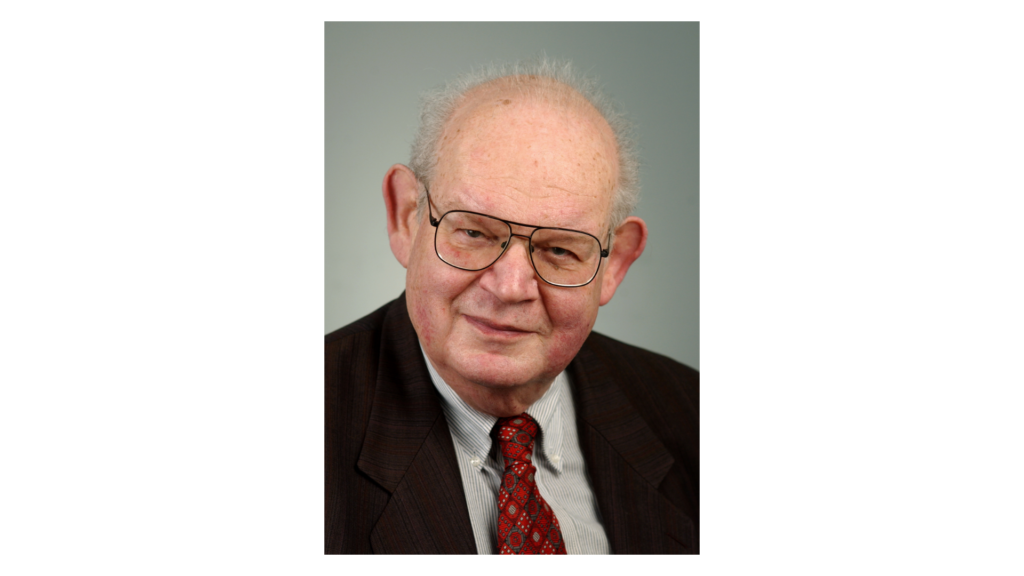
If you have ever looked at a head of Romanesco broccoli and thought, ‘why is this vegetable so geometric?’, then you have Benoît Mandelbrot to thank for the explanation. While other mathematicians were busy obsessing over smooth circles and boring straight lines, Mandelbrot was the guy who looked at the mess of the real world and decided there was a pattern in the chaos.
Early Life
Benoît was born in Warsaw in 1924 to a family with serious academic pedigree. His uncle was a mathematician, so dinner table conversations were probably more intense than for most. His family moved to France to escape the brewing trouble in the 1930s, which meant his education wasn’t as great as the other successful mathematicians. Because of World War II, he didn’t have the standard, rigid schooling most math geniuses experience. This actually worked in his favour. Instead of memorising formulas, he developed a highly visual way of thinking, seeing shapes and structures where others just saw numbers.
Achievements and Career
Mandelbrot did not spend his life in a dusty university basement. He actually spent decades at IBM, which gave him access to something most 1970s mathematicians did not have: computers with actual processing power.
In 1980, he used IBM’s tech to visualize a specific mathematical set. The result was a psychedelic, heart-shaped blob that, the more you zoom into it, reveals infinite copies of itself. It is essentially the most famous ‘maths picture’ in history – The Mandelbrot Set
Mandelbrot coined the term ‘fractal’ from the Latin word fractus, meaning broken. He used this to describe shapes that are self-similar, meaning they look the same whether you are looking at them from a mile away or through a microscope.
He also famously asked how long the coast of Britain is. The answer? It depends on how small your ruler is. This sounds like a philosophical prank, but it changed how we understand geography and physical boundaries.
Mandelbrot was a bit of a rebel in the mathematical community. For a long time, ‘serious’ mathematicians thought his work was just pretty pictures without much substance. He proved them wrong by applying his theories to everything from the way galaxies are clustered to the wild fluctuations of the stock market. He also added the middle initial ‘B’ to his name himself, even though it did not actually stand for anything.
Legacy
Benoit Mandelbrot passed away in 2010, but his work is everywhere. If you have ever watched a CGI movie where the mountains look realistic, or if you use a cell phone with a tiny internal antenna, you are using fractal technology. He took the roughness of the world and turned it into a science. He showed us that the universe is not just a collection of simple shapes, but a beautiful, infinite mess that actually makes perfect sense if you know how to look at it.