Bernhard Riemann
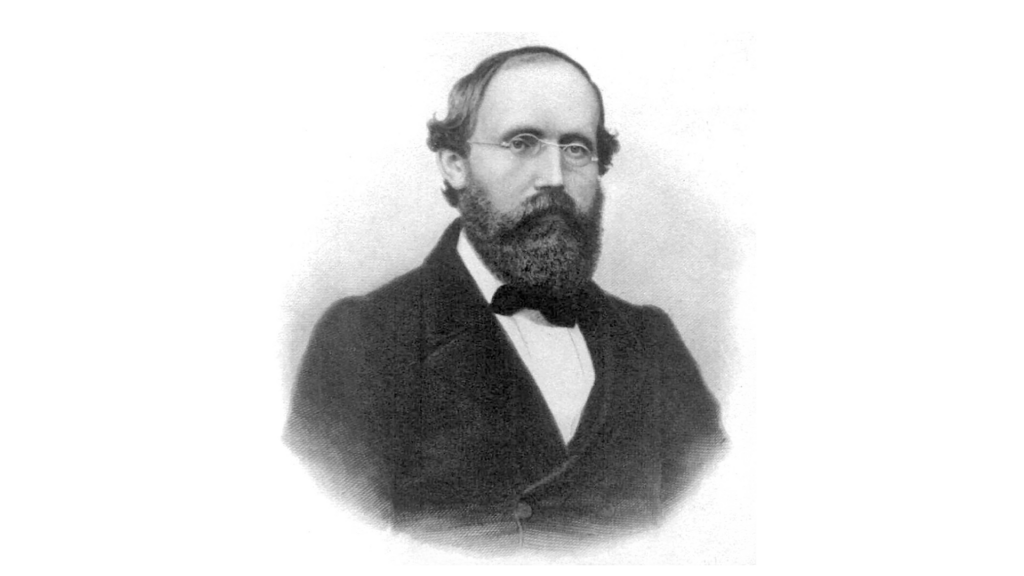
Bernhard Riemann (1826–1866) was a German mathematician who made numbers and space feel interesting. Born in 1826, he lived only 39 years, but in that short time, he invented ideas that still confuse and inspire people. He didn’t care for small problems, but big, impossible problems? Now that was more like it.
Early Life
Riemann grew up in Breselenz, a tiny village in northern Germany. His dad was a Lutheran pastor and had access to a small library. There were six kids in the family, and money was tight. Still, learning was crucial. It turned out young Bernhard loved reading books – particularly those about mathematics – and was given Leonhard Euler’s works in his teen years.
At school, his maths talent was obvious. He could understand complicated ideas before teachers finished explaining. One story says he was given an advanced maths textbook and returned it a week later claiming he had mastered it. This showed he had brains and confidence, which are two things you definitely need to survive secondary school.
When he was 14, he moved to a school in Lüneburg with tougher lessons and smarter students. Still, the teachers noticed him. After finishing school, he went to the University of Göttingen in 1846. His father wanted him to study theology, but Bernhard wanted maths. Later, he went to Berlin too, learning from some of the best minds alive.
Career
Riemann returned to Göttingen and started his academic career. In 1851, he completed his doctoral dissertation. At the time, most mathematicians avoided it, but ever the trendsetter, he dove right in. In 1854, he gave a lecture that changed geometry forever. He said, “Space can be curved.” People were shocked. Curved space? Not flat? Crazy stuff. At first, most thought he was overthinking. Later, it became key for understanding space and time in physics. Even Carl Friedrich Gauss, probably the only person more serious than Riemann, thought it was brilliant.
In 1859, he published a paper about prime numbers. Enter the Riemann Zeta function. Sounds mysterious? It is. It’s about patterns in prime numbers that nobody noticed before, work that led to the Riemann Hypothesis, which still remains unsolved. Mathematicians have been sweating over it for more than 150 years.
Achievements
In his short life, Bernhard Riemann gave an extraordinary amount to mathematics. Riemannian Geometry showed that space can curve. Mind-blowing stuff. The Riemann Zeta Function and Riemann Hypothesis showed prime numbers have secrets that Riemann uncovered and still haven’t been proved. He shaped how we study complex functions with Function Theory, stuff that is everywhere in maths and science today.
Legacy
Riemann died in 1866 in Italy of tuberculosis. The fellow had a pretty short life. That being said, in his forty-odd years, he left a huge impact. His ideas are everywhere. Universities still teach Riemannian geometry. Physicists use curved space to describe the universe. Mathematicians still smash their heads against brick walls over the Riemann hypothesis.
His life shows something simple. You do not need fame or money or age. You need curiosity and focus and guts to tackle the impossible. Riemann had all three. And now, next time you’re stuck on your maths homework, just take a deep breath and think. That’s all there is to it.